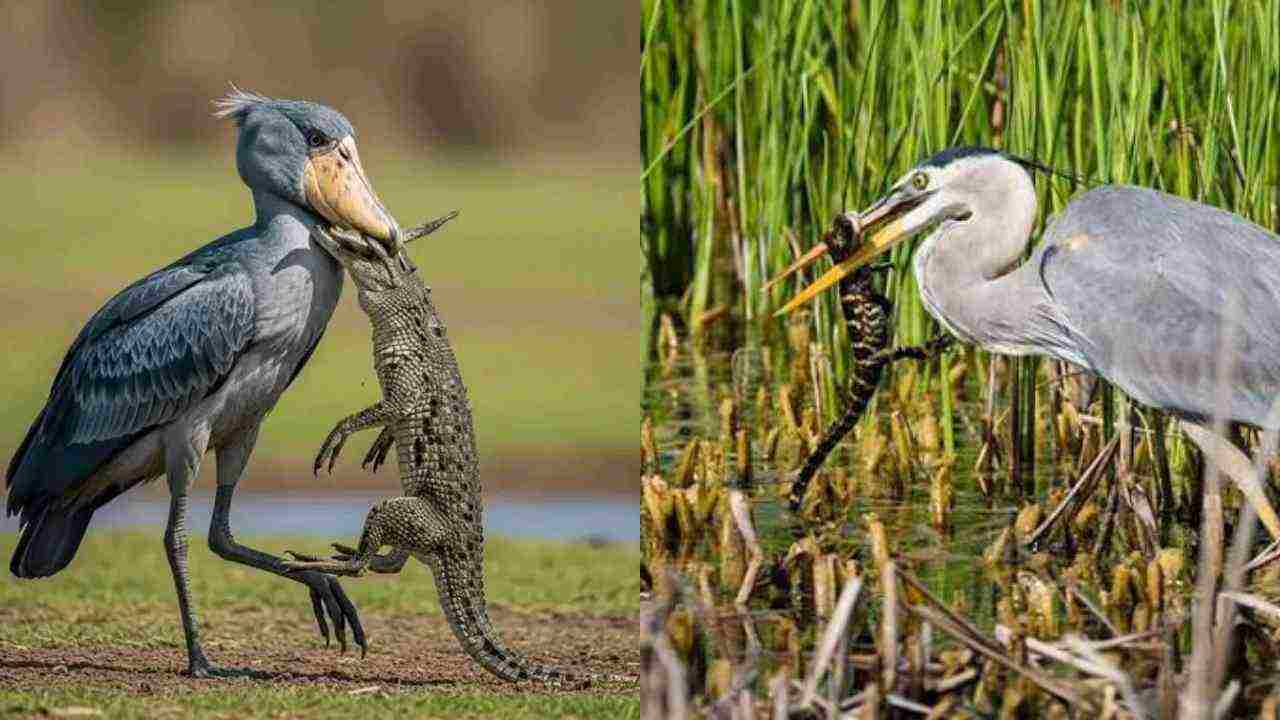
You won’t wonder if you say that you came across a picture on social media of a bird eating a crocodile.
Definitely, AI is almost destroying social media with fake pictures. You won’t believe even the original pictures are real after the implementation of AI everywhere.
But few pictures are real. You might be thinking that a bird cannot eat a crocodile, but it is true that some birds can eat crocodiles.
Certain things are applied here. If you compare an adult or any large or medium-sized crocodile, then it is not possible because of the size difference.
We know that crocodiles are apex predators and they hunt everyone but don’t get hunted by any predator. Even big cats like lions and tigers are afraid of crocodiles, especially in the water.
So this is not an easy task for birds. There are certain circumstances where birds can eat crocodiles.
99% or we can say 100% of the cases, the birds which eat crocodiles target very small or baby crocodiles.
Birds That Eat Crocodile
Not all birds can do this. Only massive bird species are capable of hunting and eating crocodiles.
1. Shoebill – The Most Famous Crocodile Hunter
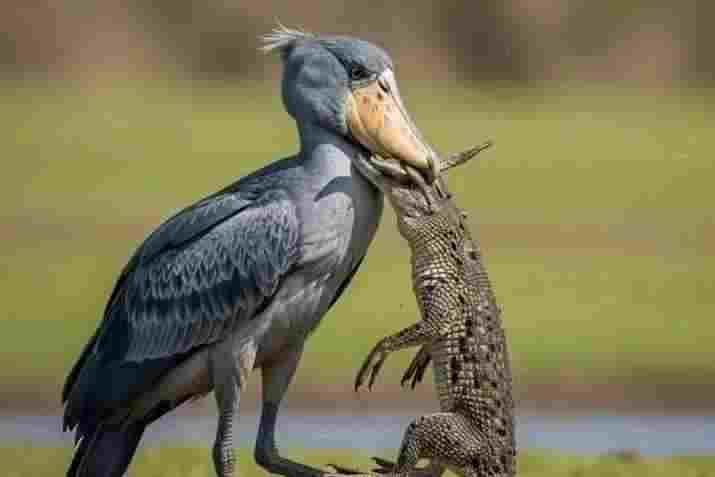
The bird first in this list is the Shoebill. This is the most common bird known for eating baby crocodiles. This is possible because of its massive size. As its name suggests, it has a large bill that makes it possible to hunt baby crocodiles.
This bird is native to the center of Africa and can feed on fish, amphibians, insects, snakes, and sometimes small crocodiles. These birds can grow up to 5 feet. That’s why some people call this a human-sized bird.
Many times photographers and wildlife lovers have captured pictures of Shoebills hunting and eating small crocodiles. Many scientists and researchers have also confirmed that Shoebill birds can really eat and hunt small crocodiles.
2. Great Blue Heron
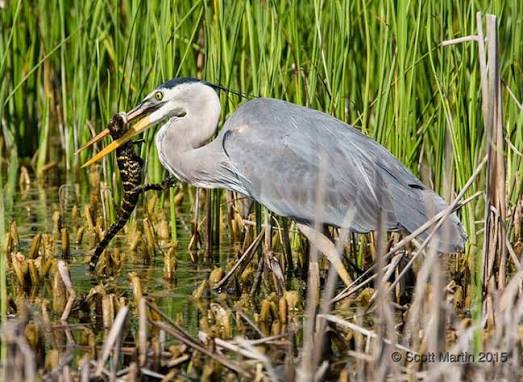
The second bird is the Great Blue Heron. Some people think that the Great Blue Heron and Shoebill are the same, but they both are different. The Great Blue Heron has a long and sharp beak which makes it easier for hunting amphibians, fish, reptiles including crocodiles and alligators.
Many times while searching for food, the Great Blue Heron witnesses small alligators and crocodiles and doesn’t miss the chance to hunt them. The Great Blue Heron hunts small crocodiles and alligators and eats them.
3. Marabou Stork
The third bird is the Marabou Stork, a strong bird also native to Africa. Because of its massive size and its appearance, when you see its face you will feel like it’s from a horror movie. This bird also looks like it is from the Jurassic period.
This bird is massive. Due to their large legs they can catch all small amphibians, fish, and sometimes get the chance to hunt baby crocodiles and alligators. They don’t miss a hunt and even eat the eggs of alligators and crocodiles.
You can recognize this bird by its pinkish outgrowth on the neck. The head looks almost bald but there could be brownish and black colored head. Its massive size helps to identify this bird.
4. African Fish Eagle (Haliaeetus vocifer)
The eagle is one of the most well-known predators among birds. Eagles hunt a variety of species, including birds, amphibians, reptiles, snakes, lizards, fish, and even small mammals. Many times, small rabbits and other animals become prey to these apex predators.
Eagles are known for their incredible eyesight. They can spot prey from very high above the ground, sometimes from more than 100 feet in the air. The African Fish Eagle is mainly found in the sub-Saharan regions of Africa. As its name suggests, it mostly hunts fish and generally lives near lakes, rivers, and other freshwater bodies.
This eagle flies high above the water and carefully watches for fish. With its excellent vision, it can suddenly dive at high speed and catch prey with its sharp talons. In rare cases, small crocodiles and alligator hatchlings may also become targets. Once the African Fish Eagle locks onto its prey, there is very little chance of escape.
Female African Fish Eagles are generally larger than males, showing sexual dimorphism in the species.
5. Black-necked Stork (Ephippiorhynchus asiaticus)
The stork is well known for living around aquatic environments, which is why it is commonly seen near ponds, rivers, wetlands, and shallow water areas. Unlike eagles, storks usually do not attack from the sky. Instead, they slowly walk through shallow water and grassy wetlands while searching for food.
While walking through these areas, they feed on snails, crustaceans, amphibians, insects, fish, and other small aquatic creatures. Sometimes, baby crocodiles and alligator hatchlings hiding in shallow water or grassy areas can also become prey to this bird.
The Black-necked Stork is a powerful bird with a long sharp beak, making it capable of catching and swallowing small reptiles. Since these birds spend most of their time near water bodies, the chances of encountering baby crocodiles are much higher.
6. Black Kite (Milvus migrans)
Many people would never expect the Black Kite to appear on this list. It is generally known for hunting small birds, rats, reptiles, and insects. However, in rare cases, Black Kites have also been seen attacking baby crocodiles and alligator hatchlings.
This behavior is mostly observed in regions such as Australia, where the hunting behavior of Black Kites is considered highly advanced. Black Kites are famous for their speed, agility, and sharp hunting instincts. One of their most interesting behaviors is known as “firehawk” behavior, where they are believed to spread fire by carrying burning sticks to flush out prey.
These birds fly high in the sky while searching for food. Once they spot prey, they suddenly dive at high speed and attack. Hatchling crocodiles and juvenile alligators are especially vulnerable because they are small and unable to defend themselves properly.
Although such incidents are rare, wildlife observations have confirmed that Black Kites sometimes prey on newly hatched crocodiles.
7. Changeable Hawk-Eagle (Nisaetus cirrhatus)
Seeing an eagle on this list may sound surprising because eagles generally do not hunt inside water bodies. However, the Changeable Hawk-Eagle has occasionally been observed attacking juvenile crocodiles and hatchlings.
This bird is mainly found in forested regions across Asia. Such hunting behavior is extremely rare and usually happens only when food is limited or when an easy hunting opportunity appears.
Larger crocodiles and alligators are far too dangerous for birds to attack, so these birds only target hatchlings or very small juveniles. If the eagle gets a chance to catch a baby crocodile moving on land or near shallow water, it may take advantage of the opportunity.
Although these cases are uncommon, wildlife researchers and photographers have occasionally documented this behavior in the wild.
8. Saddle-billed Stork (Ephippiorhynchus senegalensis)
The Saddle-billed Stork is another large stork species known for living near wetlands, rivers, lakes, and marshy areas. Many stork species are opportunistic feeders, meaning they eat whatever prey is easily available in their habitat.
These birds mainly feed on fish, mollusks, amphibians, insects, frogs, and small aquatic animals. However, in rare situations, they have also been seen eating small crocodile hatchlings and juvenile reptiles.
Since hatchling crocodiles often remain close to shallow water and grassy wetlands, they can become easy prey for large wading birds like storks. Wildlife photographers have occasionally captured such moments, proving that these birds may attack small crocodiles if given the opportunity.
Even though this behavior exists, crocodiles and alligators are not a regular part of the Saddle-billed Stork’s diet. Their primary diet still consists of fish, frogs, insects, and other wetland animals.
9. Steller’s Sea Eagle (Haliaeetus pelagicus)
Several eagle species appear on this list because of their opportunistic hunting behavior. Steller’s Sea Eagle is usually found near coastal areas, rivers, and large water bodies, where it hunts fish and aquatic animals.
While searching for fish, this massive eagle may occasionally spot small crocodile hatchlings or juvenile alligators near shallow water. In such situations, the eagle may attack if the prey appears small and easy to catch.
During crocodile breeding seasons, hatchlings often move from nests toward the water, making them highly vulnerable to predators. Many predators, including birds of prey, wait for such opportunities because baby crocodiles are easier targets before they fully adapt to their environment.
Although fish remain the primary food source for Steller’s Sea Eagles, they may sometimes hunt reptiles when the opportunity arises.
10. Goliath Heron (Ardea goliath)
The Goliath Heron is another bird species that has occasionally been observed attacking small crocodiles or alligator hatchlings. This bird mainly relies on fish, amphibians, insects, and other aquatic animals for food.
Like many wetland birds, the Goliath Heron is an opportunistic hunter. If it notices a small hatchling crocodile that can be easily captured, it may attempt to eat it. However, these birds do not attack larger crocodiles because doing so would be extremely dangerous.
Larger crocodiles can easily injure or even kill birds that come too close. Because of this risk, birds generally target only hatchlings or very young juveniles.
This list is based on wildlife observations, research findings, and photographs captured by wildlife photographers and scientists who have documented such rare hunting behaviors in nature.